Posts

The Primary Series : Standing Asanas 5 & 6

Image
V UTTHITA PARSVAKONASANA • EXTENDED SIDE ANGLE POSE Utthita=extended Parsva=side Kona=angle 1. Inhale, jump to right, approximately 4 ft apart, arms out to the sides, left heel turned in, right foot parallel to edge of mat. 2. Exhale, bend right knee over right ankle, extend right arm out as far as possible before placing it on floor outside of the right foot, either palm or finger tips, keep the pelvis tucked, open chest toward ceiling, press right knee into right arm and push on floor with back foot, feeling of being drawn and quartered. Drishti: palm of left hand. Hold for 5-8 breaths. 3. Inhale, come up. 4. Exhale down to other side, repeat 1-3. Modified posture: right elbow on right knee instead of hand to floor, back knee on the floor if necessary. VI PARIVRITTA PARSVAKONASANA • REVOLVING SIDE ANGLE POSE Parivrita=revolved Parsva=side Kona=angle 1. Exhale, turn to right bending right knee directly over right ankle. Bring left elbow on the outsi...
The Primary Series : Standing Asanas 3 & 4

Image
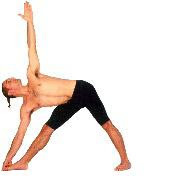
III UTTHITA TRIKONASANA • TRIANGLE POSTURE Utthita=extended Tri=three Kona=angle 1. Inhale, jump to right, right foot parallel to edge of mat, left heel turned inward, heels 3 ft apart. 2. Exhale, reach out over foot and bend to right, hold big toe of right foot with first two fingers of right hand and pull up on it, creating counter tension and oppositional stretch. Turn head to look up toward left thumb, opening chest toward ceiling. Feel the rotation of the hips as the right hip moves under and the left hip rotates open. Drishti: thumb of left hand. Hold for 5-8 breaths. 3. Inhale, come up slowly. 4. Exhale to other side, repeat 1-3. 5. Inhale, come up, keeping arms out to sides. Modified posture: right hand to ankle or shin or up as high as necessary to prevent straining back. If neck is strained, look to toes and then back up to thumb. IV PARIVRTTA TRIKONASANA • REVOLVING TRIANGLE Parivrtta=revolved Tri=three Kona=angle 1. Exhale, revolve around pullin...

The Primary Series : Standing Asanas

Image
I PADANGUSTHASANA • BIG TOE POSTURE Pada=foot or leg Padangustha=big toe Begin in Samasthiti. Jump feet hip width apart (6-8 inches), feet parallel. 1. Inhale, hands on hips, lift chest, look up and back. 2. Exhale, bend forward, hold onto big toes with middle and index fingers. 3. Inhale, head up, straighten back like a ski slope, arms straight, look up between eyebrows. 4. Exhale, move crown of head towards floor, elbows out to sides. Drishti: nose. Hold posture for 5-8 breaths. Modified posture: bend knees. 5. Inhale, head up, look between eyebrows (only your head, don’t come all the way up yet). II PADAHASTASANA • HAND UNDER FOOT POSTURE Pada=foot Hasta=hand 1. Exhale, slide hands under feet. 2. Inhale, head up, look up and extend spine, place the hands as far under the feet as possible, toes come to the wrists, the back of the wrists should be on the floor and weight off the heels. 3. Exhale, fold at waist, head towards floor. Drishti...

The primary series

There are 6 series or sequences of postures in the ashtanga yoga system. This manual focuses on the primary, or first series, which is known as yoga chikitsa (yoga therapy). It is designed to heal, detoxify, and align the body and mind, particularly the spine. The sequencing of postures is a science, set up so that each asana provides a necessary foundation for what follows. We always begin with the sun salutations and standing postures to generate heat and connect with the breath. The first half of the primary series (which begins after the standing postures) is mostly forward bends, working the hamstrings, hips, and back. The middle section focuses on flexibility and the third part combines more flexibility with strength postures. The finishing postures are the same regardless of what series you are practicing. They are restorative postures designed for cooling down, balancing out the body, and integrating the effects of the practice. This is the vinyasa system, a breathing/movin...

Surya Namaskara

Image
Practice Surya namaskara B Begin in Samasthiti, equal standing 1. Inhale, bend knees, lift arms, palms together over head, gaze at thumbs. 2. Exhale, straighten legs to a forward bend, Uttanasana, gaze at nose. 3. Inhale, head up, lengthen spine, gaze at third eye. 4. Exhale, jump back to Chaturanga Dandasana. 5. Inhale, lift chest, head back to Urdhva Mukha Svanasana, upward facing dog, gaze at sky. 6. Exhale, lift hips to downward facing dog, Adho Mukha Svanasana, gaze toward navel. 7. Inhale, right foot forward, left heel turned inward. Virabhadrasana, lift arms, palms together. Right knee bent, left leg straight with back foot pressed into floor. Gaze at thumbs. 8. Exhale, back to Chaturanga Dandasana. 9. Inhale, upward facing dog, Urdhva Mukha Svanasana 10. Exhale back to downward dog. 11. Inhale, left foot forward, right foot turned in at an angle, Virabhadrasana; lift arms above head, gaze to thumbs, left knee bent. 12. Exhale back to Chaturanga....

Sun Salutation : The Dawning of a Ritual

Image
Ritual Connects Us To The Absolute By tradition, at dawn, the yogis practiced greeting the sun with a salutation. A yoga session is incomplete without it. An ideal exercise to get you moving, Surynamaskara welcomes the new day, preparing for the asanas, heating up the body, toning up the muscles, quickening and intensifying the respiration and cardiac rhythm. The sun salutation is the foundation of your practice, it establishes the connection of movement and breath, uniting body, mind, and spirit. Not only is the sun salutation a preparation for the rest of your yoga practice, but it is a complete exercise within itself. Suryanamaskara tones up the digestive system by the alternate stretching and compression of the abdominal region. It massages the inner organs, stomach, liver, and spleen. It activates digestion and aids in reducing constipation. Synchronizing breath with movement, the lungs are thoroughly ventilated and the blood oxygenated, creating a detoxifying effect. ...

Pranayama : Your Practice

Pranayama Sequence Once you get the feel for quality of breath and the bandhas you can practice this pranayama sequence. Begin with 3 ujjayi breaths (3 full breaths with sound) I. Baya kumbhaka - exhale retention Take a deep breath in and then exhale fully. Hold the exhale. Engage mula bandha, uddiyana bandha and jalandara bandha. Begin with a 5 second hold and build from there. Repeat 3 times 3 ujjayi breaths II. Antara kumbhaka - inhale retention Take a full inhalation and hold. Engage the bandhas. Begin with 5 second hold. Repeat 3 times. 3 ujjayi breaths III. Antara kumbhaka and baya kumbhaka Inhale fully and hold 5 seconds. Exhale and hold 5 seconds. Engage all three bandhas. Repeat three times. As your abiliity to control your breathe improves, increase the seconds of the holds. Lay down and rest at the end to integrate the pranayama practice. Feel the effects on your body and mind. your practice Integration The Challenge The true challen...